The City Followed Every Rule on Arcadian Square. Almost Nobody Found Out.
August 23, 2026
There’s a 12-acre rezoning application working its way through City Hall right now. It’s at the southwest corner of 48th Street and Indian School Road, wrapped on two sides by Arcadia High School, with the Crosscut Canal path along its eastern edge.
This summer, the Arcadia Osborn Neighborhood Association surveyed its members about the project Arcadian Square, a proposed 60-home gated community 185 residents responded.
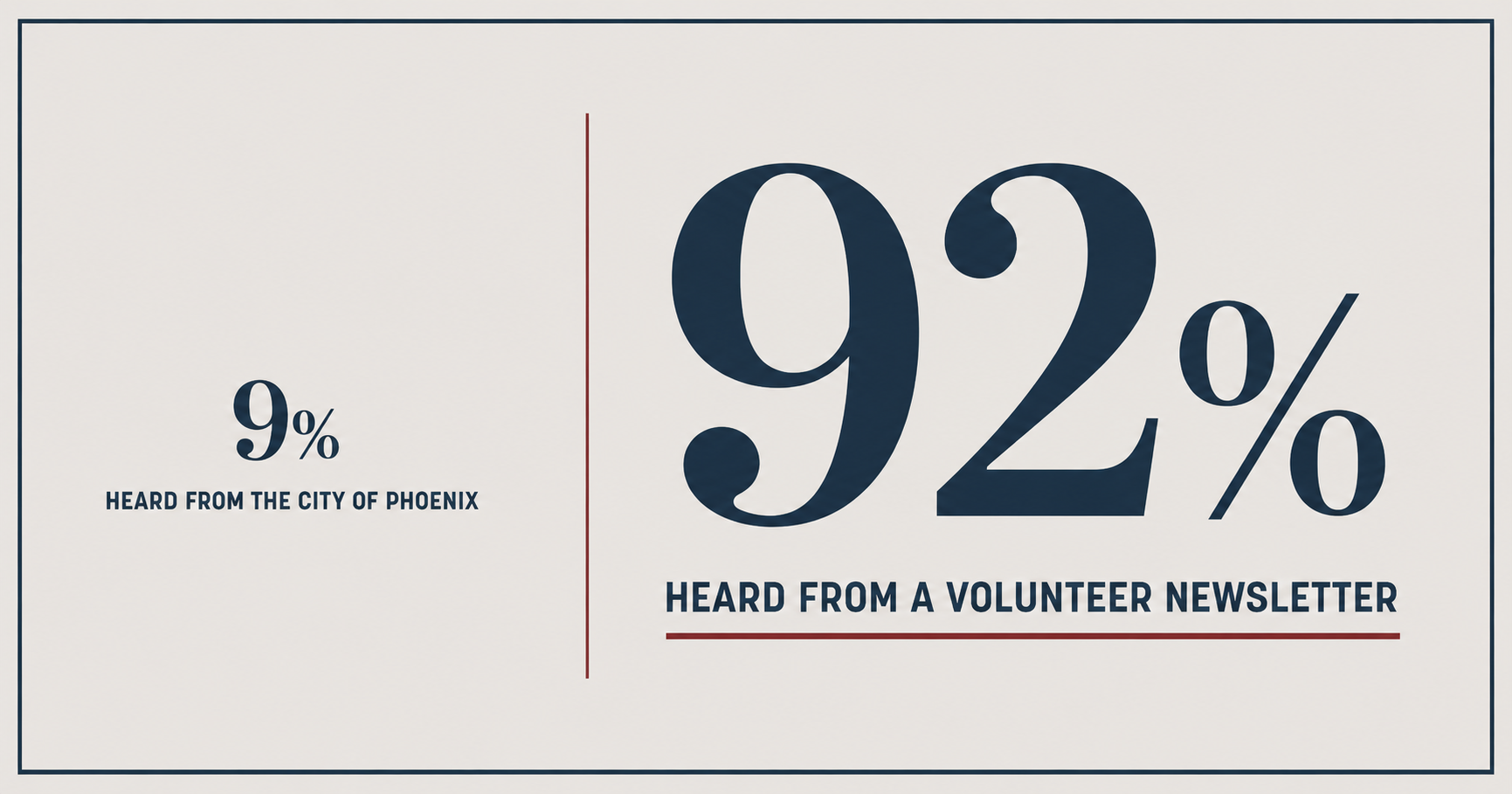
Nine percent of them had gotten any information about it from the City of Phoenix. Ninety-two percent got it from AONA’s volunteer email newsletter.
The easy version of this story is wrong. The City didn’t break any rules. Every notification requirement was met. Letters went to property owners within 600 feet. Registered neighborhood organizations within a mile were notified. A four-by-eight-foot sign went up on the property.
That’s the problem. The City followed every rule on the books, and one resident in eleven found out.
What "notified" actually means in a Phoenix rezoning
Six hundred feet is about two blocks. For a corner lot, that might reach the people who would live with it. For twelve acres next to a public high school, at an intersection thousands of people drive through every morning, it reaches only a fraction of the people whose daily lives change.
The notice itself is a legal document. A case number, a zoning designation, a date. It doesn’t explain what a PUD is, that two separate maps are being changed, or which of the three public bodies involved actually decides anything.
That’s where Arcadia is now. Residents rated their understanding of the project at nearly 4 out of 5. They rated their understanding of the process at 2.4. Seven in ten said they wouldn’t know how to submit a comment. Sixty-two percent had taken no public position at all. Another twenty-eight percent said they meant to, but hadn’t.
That’s not apathy. That’s a few hundred people who care a great deal and can’t find the door.
What's actually in the Arcadian Square filing
I spent a few days reading the actual filing. The development narrative, the site plan, the standards. It’s what I did for a living before I ran for anything.
The project is presented as 60 homes. The requested standards permit six dwelling units per acre. On 12.62 acres, that’s roughly 75 homes, about 25% more than what’s in the renderings.
At the July neighborhood meeting, residents were shown a detailed safety package for the canal crossing: a lighted stop sign, gate-activated flashing warnings, a speed table. In the binding narrative, that infrastructure “may include” those things. May include is not a commitment to any of it.
The narrative says “detached” homes. The site plan sheet says “semi-attached.” The standards allow zero-foot rear setbacks and set no minimum lot width or depth at all. The land use change isn’t from commercial, as most people assume. The site’s General Plan designation is Parks/Open Space.
I’m not telling you the project should be denied. I haven’t seen the traffic study. Nobody has, because it still isn’t public a month after traffic conclusions were presented at a neighborhood meeting.
I’m telling you because every one of those facts sits in a public document that a resident had no realistic way to find, read, or understand in time to say anything about it.
That’s the failure. Not the project. The fact that you’d need my résumé to know what’s being proposed in your own neighborhood.
The seven-day rule almost nobody knows about
Here’s the one I didn’t know until I went looking, and I’ve been through a lot of these.
After the Planning Commission votes on a rezoning, the City Council can adopt that recommendation with no public hearing at all unless someone files a written objection within seven calendar days.
Seven days. After a meeting most people don’t attend, many don’t know happened, under a rule almost nobody has heard of.
A neighborhood can do everything right. Show up. Organize. Prepare. If nobody files that piece of paper inside that window, the case gets decided by a body they never got to address.
That’s a legal, functioning, entirely rule-following process. It’s also indefensible.
Four things I'd change at City Hall
None of this requires villains. It requires standards that have kept pace with the city.
Publish traffic studies when the City accepts them, with enough time before a hearing for residents to read them.
Scale the notification radius to the project. Six hundred feet shouldn’t be the standard for twelve acres and a corner lot alike.
Build real case pages. What’s proposed, what changes, every document, every date, and how to comment. Put it in words a person can use.
End silent ratification. A rezoning this size should get a Council hearing, full stop.
None of these are partisan. None cost much. All of them would have changed what happened in Arcadia this summer.
How to comment on the Arcadian Square rezoning
If you want to be heard on this case, written comment counts at any point before the final decision. Email the Camelback East village planner at anthony.grande@phoenix.gov and reference case Z-101-26-6. The first Village Planning Committee hearing is expected in October.
Remember the seven-day window. That’s the one nobody tells you about.
Ninety-two percent of the informed residents in that survey got there because a handful of volunteers did work the City should have been doing. That shouldn’t be how anyone finds out what’s being built next to their kid’s school.
I’m running for City Council because I’ve spent my career on the other side of processes like this one. Most of what frustrates people about City Hall isn’t ideology. The machinery was built for the people who use it every day, not the people who live with what it produces.
That’s fixable.
Michael Del Prete is a business owner and real estate professional running for Phoenix City Council in District 6. Survey data is from the Arcadia Osborn Neighborhood Association’s resident survey conducted in late July and early August 2026, with 185 respondents. Development standards cited are from the applicant’s PUD development narrative on file with the City of Phoenix, case Z-101-26-6.