Could a Fourplex Be Built Next Door to You?
August 14, 2026
A neighbor stopped me outside of Last Chance on 20th St. a few weeks ago and asked me a question I'm hearing more often:
"Is the state about to let somebody build a fourplex next to me?"
Fair question.
The honest answer is more useful than the headline. So I did what I would want a councilmember to do: I read the state law, Phoenix's ordinance and the map.
Here's what is actually true.
A quick disclosure, because you should know where I'm coming from: I lead the Arizona Real Estate Investors Association and have spent much of my career working with housing, permitting and financing. That experience is exactly why I'm not going to sell you a scary version of this law or a rosy one.
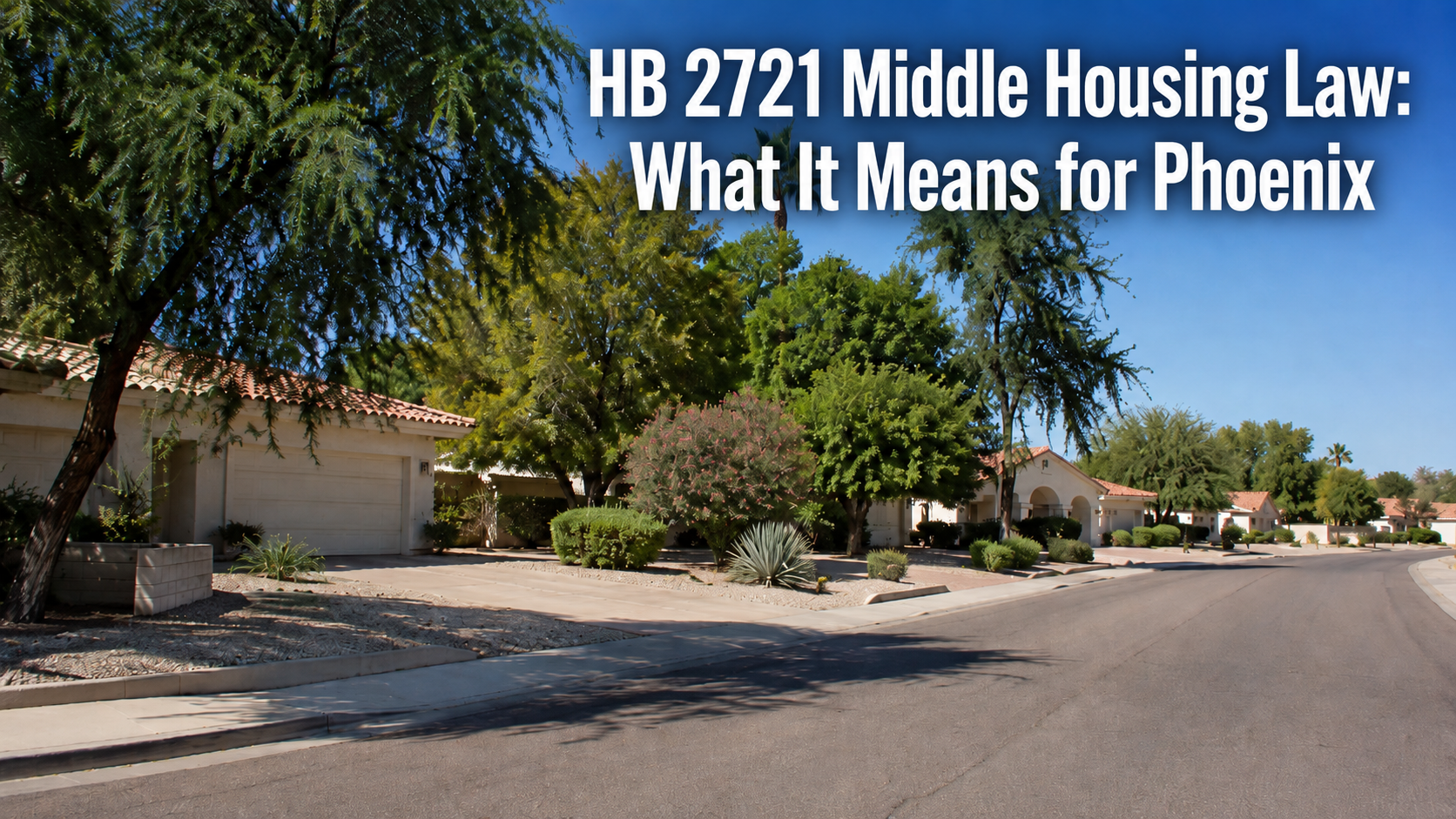
What Is HB 2721, Arizona's Middle Housing Law?
HB 2721 passed the Arizona Legislature in 2024 and is now A.R.S. § 9-462.13. It applies to Arizona municipalities with populations of 75,000 or more. Cities were required to comply by January 1, 2026.
The law requires those cities to allow "middle housing" duplexes, triplexes, fourplexes and townhomes in two circumstances:
- On lots zoned for single-family residential use within one mile of the city's designated central business district.
- On at least 20% of the lots in new residential developments larger than 10 contiguous acres.
The law also limits what cities can require. A city cannot require owner occupancy, restrict middle housing to one story, require a floor-area ratio below 50%, mandate more than one off-street parking space per unit, require fire sprinklers when they would not otherwise be required, or subject middle housing to a more restrictive review process than a single-family home. (The full list is in the Legislature's own bill summary.)
The law also included a serious consequence for cities that failed to comply: middle housing would become permitted on all single-family residential lots in that city without local limitations.
That deadline explains why Phoenix acted when it did.
Does HB 2721 Apply to Arcadia, Biltmore, North Central or Ahwatukee?
The short answer is: generally, no not today.
On November 19, 2025, the Phoenix City Council unanimously adopted its Middle Housing Text Amendment and an accompanying overlay map.
The Middle Housing Overlay District applies primarily to properties within one mile of Downtown Phoenix. It includes neighborhoods such as Willo, Coronado and Garfield, but it does not reach the residential core of District 6.
The second part of the law applies to new residential subdivisions of more than 10 contiguous acres. Phoenix created a process allowing qualifying developments to apply the middle-housing overlay to a portion of their lots.
That is something residents should continue watching. But in largely built-out areas such as Arcadia, Biltmore, North Central and Ahwatukee, new residential subdivisions of that size are uncommon.
So, if you own a home near 44th Street or Chandler Boulevard, HB 2721 did not suddenly rezone your block for fourplexes.
What Arizona's Middle Housing Law Does Not Do
Several claims get repeated at neighborhood meetings that are not supported by the law.
Does HB 2721 Override HOA Rules and CC&Rs?
HB 2721 changes municipal zoning rules. The bill text does not expressly invalidate private deed restrictions or HOA covenants.
That distinction matters. A city may permit a particular use while private restrictions on a property still prohibit it.
The interaction between state housing mandates and private covenants could eventually produce litigation, so I would not promise that every potential dispute is settled. If you want certainty about your property, review your recorded CC&Rs and consult a qualified attorney.
Does HB 2721 Force Anyone to Sell or Redevelop Their Home?
No. The law changes what a willing property owner may be permitted to build. It does not take anyone's home or require an owner to redevelop a property.
Can One Lot Be Split Into Four Separately Owned Properties?
Allowing four homes on one lot is not the same as allowing the lot to be split into four individual parcels. Phoenix has specifically said its ordinance does not authorize smaller lots or more lots than existing property entitlements allow.
Are Historic Districts Exempt From the Middle Housing Law?
Phoenix's historic-preservation procedures may still apply, but state law did not provide a blanket exemption for historic districts. That unresolved conflict is one reason residents of historic neighborhoods pushed for additional legislation.
The Real Debate: Local Control, and Who Ends Up Owning Phoenix Homes
This is where I part company with both sides.
City leaders are right that the Legislature limited Phoenix's local authority. But Phoenix also needs to ask why the Legislature believed it had to intervene in the first place.
For years, housing became more expensive while permitting remained slow, starter homes disappeared and attainable homeownership moved further out of reach.
In May 2026, Phoenix announced that four families would receive new affordable homes in Sunnyslope through a partnership with Habitat for Humanity. The city described them as the first completed homeownership units produced through its city-owned-land effort.
Four homes.
That is meaningful for those four families and Habitat's volunteers and donors deserve real credit for it. But it is nowhere close to the scale Phoenix needs.
When local government moves that slowly, the Legislature eventually steps in. And when it does, it usually writes statewide zoning rules with a blunt instrument.
HB 2721 also left out an important issue: ownership.
The law legalizes a building type. It does not require any of the new homes to be available for individual purchase. A fourplex could provide four ownership opportunities or it could become four rental units owned by one investment company.
The Phoenix metro area has led the country in build-to-rent development. Rental housing is an important part of the market, but building more units does not automatically create more homeowners.
That is my concern about neighborhood character. It is not simply about whether a building has one front door or four. It is also about whether families have a realistic opportunity to own part of the neighborhood in which they live.
A well-designed duplex or townhome does not automatically harm a street. But a housing policy that produces density without creating attainable ownership is incomplete.
What Happened to HB 2375, the Historic Neighborhood Exemption?
In 2026, Rep. Matt Gress introduced HB 2375 to address how the middle-housing law applies to historic neighborhoods.
The bill passed the Arizona House but did not receive final approval in the Senate before the legislative session ended.
Whatever your position on that proposal, the concern remains unresolved. Historic neighborhoods deserve clear standards that protect genuinely contributing structures without shifting every new housing obligation onto less politically connected neighborhoods.
What I Would Do About Middle Housing on the Phoenix City Council
1. Give Residents a Usable Address Lookup
Phoenix should provide a simple tool on its website: enter an address and see the applicable zoning, overlays, historic restrictions and basic development rights.
Residents should not have to search through staff reports and complicated zoning PDFs to understand what can be built on their property or next door.
2. Use City-Owned Land to Create Ownership Opportunities
When Phoenix makes appropriate city-owned land available for housing, it should prioritize projects that create individually deeded, attainable homes not only more rentals.
That could include townhomes, condominiums, community land trusts and fee-simple lots, with owner-occupant opportunities incorporated where legally feasible.
The state may not require ownership under HB 2721, but Phoenix can use its land and development agreements more intentionally.
3. Create Better Neighborhood Notification
State law limits Phoenix's ability to impose a more burdensome approval process on middle housing than it imposes on single-family homes. But that should not stop the city from creating an automated courtesy-notification system for nearby residents when significant permits are issued.
Notice should inform people not give government another excuse to delay a lawful project.
Residents should not learn that something is being built next door only when the construction crews arrive.
4. Get Ahead of the Legislature Instead of Reacting to It
The best way to reduce future state preemption is for Phoenix to produce measurable results: faster permitting, more attainable for-sale housing and clear rules residents can understand.
If Phoenix continues reacting only after deadlines arrive, the state will continue making local land-use decisions for us.
5. Support a Workable Historic-Neighborhood Standard
I would support a narrow, defensible standard that protects genuinely contributing historic structures.
I would not support a blanket exemption that shifts all future housing growth onto working-class neighborhoods with less political influence.
The Bottom Line for District 6 Homeowners
HB 2721 is not the end of your neighborhood.
For most District 6 homeowners, it currently changes very little. But the law is a warning about how housing policy is being made: decisions arrive fully formed, from a level of government residents were not watching, on a timeline few people understood.
Phoenix needs more housing but it needs the right housing. That means more attainable homes people can purchase, faster and more predictable permitting, understandable rules, and honest communication with the residents affected by those decisions.
You deserve a councilmember who reads the law, understands housing and tells you what it actually means even when the truth is less dramatic than the headline.
I would rather tell you the truth about a fourplex that probably is not coming than send you a fundraising email designed to make you afraid of one.