The Truth About Police Staffing in Phoenix
August 5, 2026
Michael Del Prete | Candidate, Phoenix City Council District 6
Public safety is the first job of any city. Not the tenth. The first. So let's talk honestly about where Phoenix actually stands, because the numbers tell a story City Hall doesn't love to say out loud.
I went and pulled them. Here's the truth.
Phoenix funds 3,125 officers. It can't fill the jobs.
For four years running, the city has budgeted for 3,125 sworn police officers. That's the number on paper.
The number in reality? As of early this year, about 2,460 fully trained officers were actually on the job, with roughly another 126 still in the academy. That leaves the department more than 500 officers short, running at about 83% of what the city itself says it needs.
And here's the part that should bother you. Even that 3,125 target is old. One councilman flat-out called it "a fictitious number based on a budget from several years ago." Phoenix has kept growing. The staffing target hasn't. So we're falling short of a goal that was already too low for a city of more than 1.6 million people.
The $98 million bill for coming up short
When you don't have enough officers, the ones you do have work more hours. A lot more.
Last fiscal year, Phoenix spent $98 million on police overtime. Not on new hires. Not on retention. On overtime. And about 80% of it was mandatory, meaning officers didn't choose those hours, the shortage forced them.
Think about what that is. It's the most expensive possible way to run a police department. You're paying a premium, night after night, to cover shifts you should have staffed in the first place. That's not a plan. That's a bill you get stuck with because nobody fixed the underlying problem. Tired officers, stretched thin, at time-and-a-half. Everybody loses.
So why can't Phoenix keep officers?
This is the question that matters, and the answer isn't simple, but it's not a mystery either.
Officers are retiring faster than the city can replace them. Other departments recruit experienced Phoenix cops away with better pay and less hassle. Hiring has been hard everywhere since 2020. And when the ones who stay get mandated into endless overtime, burnout pushes even more of them out the door. It feeds on itself.
The city will point to recruiting campaigns, and yes, applications are up. That's good. But you don't fix a decade-long retention problem with a marketing push. You fix it by making Phoenix a place officers want to stay, and by being honest that overtime is a symptom, not a solution.
What the shortage costs you when you dial 911
Numbers on a budget sheet feel abstract until it's your call.
Nationwide, police answer the most urgent, life-or-death calls in about six and a half minutes on average. In Phoenix, those top-priority calls run about six to nine minutes, depending on which precinct you're in and what time it is.
But most calls aren't classified top priority. A burglary that just happened. A fight that's heating up but hasn't turned violent yet. In Phoenix, those Priority 2 calls average twenty to forty minutes. That's a long time when you're the one waiting.
And the department is honest about why. As one assistant chief put it, "It's not always that we don't have enough officers. Sometimes we just don't have enough officers in the right spot." That's the shortage in one sentence. Too few people, spread across too much city, sent wherever the fire's hottest that minute.
To be clear, this isn't a crime wave. Violent crime in Phoenix has actually come down over the last couple of years, and that's real progress worth saying out loud. The problem is the margin. When coverage is this thin, there's no slack in the system. And you feel it most on exactly the night you needed someone fast.
What this means for Ahwatukee
Here's where it gets personal for us.
Ahwatukee doesn't have its own police precinct. We're part of the South Mountain Precinct, which covers about 115 square miles and 272,000 people across a huge stretch of south Phoenix. Patrol officers get assigned based on where the calls come from. Ahwatukee, thankfully, is a lower-crime area. So it generates fewer calls. So it gets fewer officers.
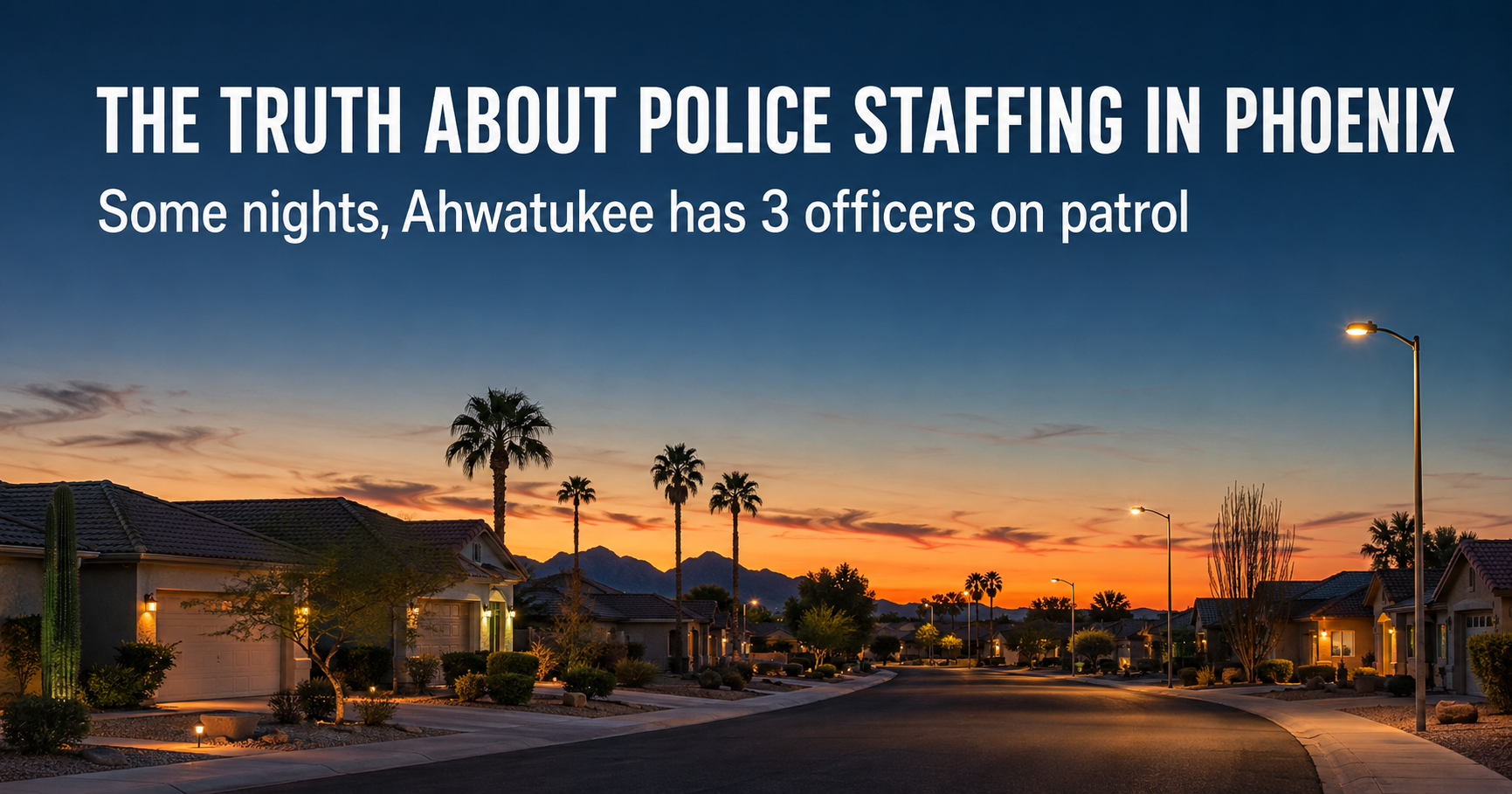
How few? A Phoenix police sergeant said there are many nights when she has just three officers to patrol all of Ahwatukee.
Three. For a community our size.
That's not a knock on those officers. They're doing everything they can with what they're given. It's a knock on a system that treats a shortage as something residents just have to live with, and never quite gets around to fixing.
The councilman in charge of this sits in District 6
Here's what most residents don't know. The City Council body that oversees police staffing, overtime, and how the department is run is the Public Safety and Justice Subcommittee. And the person who chairs it is our own councilman, Kevin Robinson.
He's held that chair for about two years. His own campaign describes him as playing "a key role in shaping community-informed safety strategies and advancing funding to support public safety initiatives." So this isn't an outside critique. It's his stated job, and he's running on it.
This is also where those numbers live. The $98 million in overtime and the 500-plus officer shortfall were presented to this subcommittee. Read into the record. Briefed and discussed.
And year after year, the shortage holds and the overtime climbs.
I want to be fair here, because Robinson spent 36 years at Phoenix PD and rose to assistant chief. On paper, he's the most qualified public-safety voice on the council. Which is exactly why this is worth asking out loud. If the person overseeing police staffing is a former assistant chief, and the department is still 500 officers short and burning $98 million a year in overtime, then what is the oversight actually accomplishing?
Oversight that reads the numbers every year but never moves them isn't really oversight. And after two years in that chair and four years as council "we're aware of the problem" isn't an answer anymore. It's the whole problem.
Where I stand
I'm not going to insult you by promising I'll personally hire 500 officers on day one. A council member can't do that, and you've heard enough people promise things the job can't deliver.
Here's what the job actually can do, and what I'd fight for.
Make police staffing a real budget priority, not a fictitious number on a spreadsheet. If we say we need 3,125, fund the recruiting and retention to actually get there. And if the honest number for a city this size is higher, say so.
Stop treating $98 million in overtime as normal. That money is evidence of a problem, not a fix. Shift the focus to keeping the officers we train instead of burning them out and paying a premium to backfill the coverage.
Demand straight answers on deployment. Ahwatukee residents deserve to know how many officers are actually assigned here, and to get our fair share within the precinct instead of being the quiet corner that always gets thinned out.
And treat public safety like the first job of the city, because it is. Not as a line item briefed once a year and left to drift.
You deserve a council member who reads the numbers, tells you the truth, and treats your safety like it's the whole point of the job. That's the standard I'll bring.